Rugby ball sales

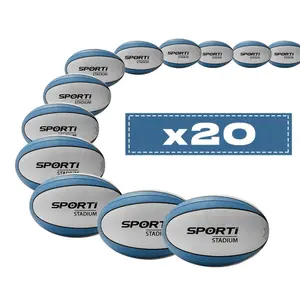
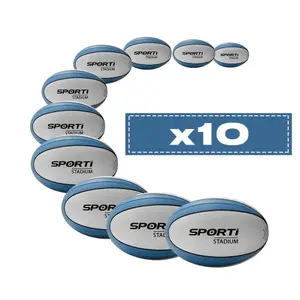
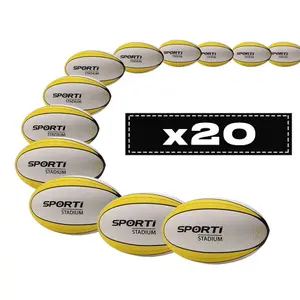
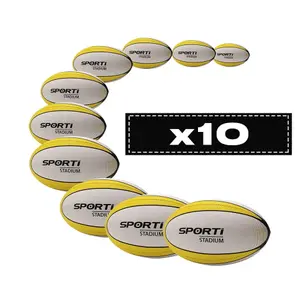
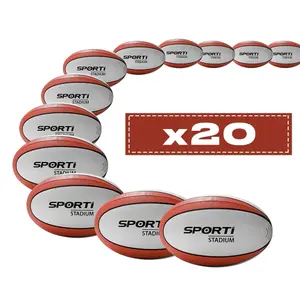
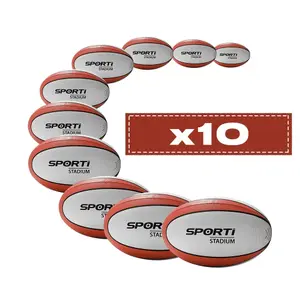


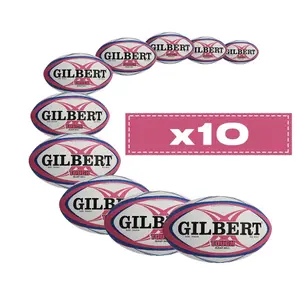
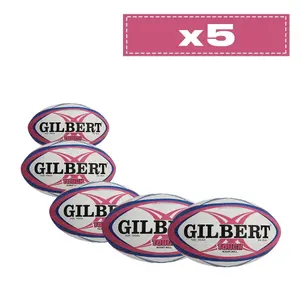
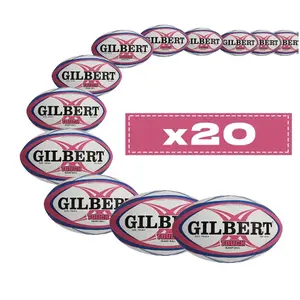
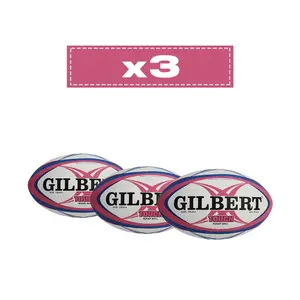


This selection of discounted rugby balls includes training balls Gilbert and Sporti, match balls Gilbert and Berugbe, supporter balls in the colours of nations and clubs, as well as a foam ball for beginners. The sizes range from size three for the youngest to size five for adults, with our guidelines to help choose and maintain your ball properly.
The oval ball at a reduced price.
What size ball according to age
The size of the ball corresponds to the player's age. The size three, about fifty to fifty-five centimetres in circumference, is suitable for children up to around nine years old; the size four, a bit larger, is for those aged ten to fourteen; the size five, used in official matches, takes over for the older kids and adults. A ball that's too big for small hands can mess up the passing technique and quickly discourage a beginner. Training balls Gilbert are available in these three sizes, allowing a rugby school to follow each category with the same model and feel of the ball.
The other equipment
The sales also include:
All equipment sales are gathered on the equipment sales page.
Training, match or supporter ball
The training ball focuses on durability: the Gilbert G-TR4000, made of three layers of polycotton, keeps its shape throughout the sessions, and the training ball Sporti is used for beginner workshops. The match ball, more responsive, offers a finer grip and a more stable trajectory when kicked; the Berugbe Elipse and the Gilbert Touch, designed for touch rugby, are examples of this. The supporter ball, in the colours of the XV of France, Canada, Uruguay, Tonga or ASM Clermont Auvergne, is collected or gifted; it's fun to toss around in the garden, but its printed surface is not meant for heavy use.
Inflating and caring for your ball
A well-inflated ball should feel firm under thumb pressure, but not hard as wood. You wet the needle before sliding it into the valve, without forcing it, and you respect the pressure indicated next to it; a pressure gauge helps avoid guesswork. After a session in the rain, wipe off the mud, let it dry at room temperature, and slightly deflate the ball if it needs to be stored for a long time. Sunlight and the heat from a car boot can damage the bladder and peel off the panels. The sales come at just right to replace some tired balls before the new season starts.
The other good deals
Good deals can also be found in the good deals, clearance, Black Friday. The new arrivals showcase the latest collections. The highlights of the year follow a stable order: the Black Friday at the end of autumn, the Christmas holidays, the winter sales, the French Days in spring, then the summer sales and back to school.
Frequently asked questions
Why is the rugby ball oval?
In the nineteenth century, a pig's bladder was inflated and covered with a sewn leather outer layer, giving the ball its elongated shape. The shape was later standardised, and today the oval shape makes it easier to pass and play with the foot.
Why are rugby balls called Gilbert?
William Gilbert, a shoemaker based in Rugby, began making balls for the nearby school as early as 1823. His name became the brand that equips today’s biggest competitions with balls.
What is a foam ball used for?
The foam ball, like the Sporti Soft'rugby, is used for teaching the littlest ones, at school or in the gym: it doesn't hurt on impact and doesn't bounce much. It helps with catching and passing skills without fear.
Why buy a pack of balls?
A pack of ten balls equips an entire session: each pair or workshop has its own, which increases the number of touches on the ball. Clubs and physical education teachers benefit from saving time and improving organisation.
Which ball to choose for touch rugby?
Touch rugby is played with a lighter and smaller ball than the fifteen-a-side rugby ball, with a fine grip for quick passing. The Gilbert Touch has been designed for this non-tackle practice.