Gilbert Cage, rugby shoes
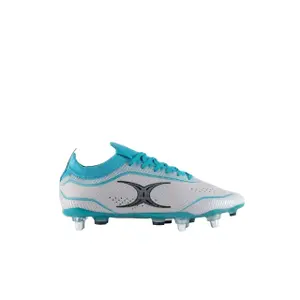
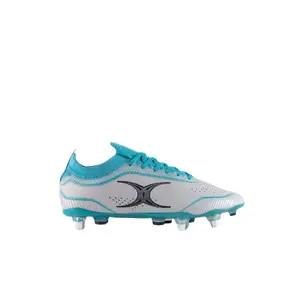
Our Gilbert Cage page features the range of rugby shoes that Gilbert is known for, with its mesh structure wrapping around the foot. Designed for agile players, wings, centres, half-backs, or mobile back rowers, it comes in the Pace version, with six removable studs for soft ground, and in the Torq version, which has a hybrid sole combining removable and moulded studs.
A Gilbert range for the pitch.
A cage shaft to hold the foot without weighing it down
The Cage range gets its name from its construction: a mesh cage that wraps around the foot, combined with a specific lacing system, adjusts the shoe closely to each person's foot shape. This structure holds the midfoot during pressure changes without using a thick shaft, keeping the shoe light and well-ventilated. The synthetic upper withstands the abrasions from rucks and opposing studs, while the rubber sole absorbs repeated sessions. This results in a precise fit, appreciated by players whose game relies on agility rather than power.
The other Gilbert ranges
The Gilbert shoes also come in:
All the Gilbert shoes are gathered on the Gilbert page.
Cage Pace or Cage Torq: pure speed or changing terrain
The Cage Pace features six screw-in studs: it is aimed at backs and fast players playing on soft pitches, where long studs are needed to secure footing when accelerating. Its Pro variant, more advanced, further refines the hold thanks to the lacing and the cage. The Cage Torq adopts a hybrid sole: screw-in Pro Lite studs combined with moulded TPU studs. This combination provides traction without unbalancing or weighing down the foot, an asset when the ground shifts from soft to firm over the weeks.
Six-stud sole: which position, which terrain
Six studs instead of eight is a choice for mobility. With fewer anchor points, the foot pivots more freely in turns and accelerations, and the shoe gains lightness over eighty minutes. Conversely, push stability is lessened: a prop or a second-row player would prefer a sole with eight studs. However, back row players with a runner's profile, halves, and backs find this suitable. On the hardened surfaces of autumn and spring, the Torq hybrid, less aggressive underfoot, is easier on the joints than long screw-in studs.
Good deals
Good bargains can be found in good deals, promotions, clearance, sales, and Black Friday. The new arrivals showcase the latest models. The highlights of the year follow a stable order: the Black Friday at the end of autumn, the year-end holidays, the winter sales, the French Days in spring, then the summer sales and the new term.
Frequently asked questions
Is the Gilbert Cage suitable for a winger?
Yes, it’s one of its natural audiences: six studs for acceleration, a lightweight mesh shaft, and precise hold in turns. A winger playing on heavy pitches in winter will choose the Cage Pace, fully screw-in.
Is the mesh structure comfortable from the first match?
The mesh quickly adapts to the foot, but the rule of short first outings applies: two or three training sessions before a match. The lacing then allows adjustment of the tension on the midfoot to avoid pressure points.
Can the studs of a Cage Torq be replaced?
The screw-in Pro Lite studs can be changed with the supplied key, just like on any screw-in shoe; the moulded TPU studs, attached to the sole, cannot be replaced. When these are worn out, the entire pair needs to be renewed.
Is the Cage suitable for wide feet?
Its fit, tightened by the cage and lacing, is mainly for standard to narrow width feet. A player with wide feet, or whose foot swells at the end of a match, will be more comfortable in a wider-fitting forefoot shoe, like the Power from Gilbert.
How to care for the mesh of a Cage shoe?
Let the mud dry before brushing it off, rather than scrubbing a wet mesh that holds onto dirt. A wipe with a damp sponge completes the cleaning; then stuff with paper and keep the pair away from any source of heat, which could weaken the seams.